The artist once said: ‘It is as if my mind creates shapes that I don’t know about. I get the shape in my head, and sometimes I know what it comes from and sometimes I don’t.’ 1Quote from the documentary: ‘Georgia O’Keeffe’, 1977, written and directed by Perry Miller Adato.
Her name was Georgia O’Keeffe, and at the time she was born, the planet Pluto was yet to be discovered. Being prominent in her chart she may, however, intuitively have sensed impulses from the archetype in her psyche. Such are the transpersonal planets — they bring us messages and insights that are unfamiliar to our learned experience.
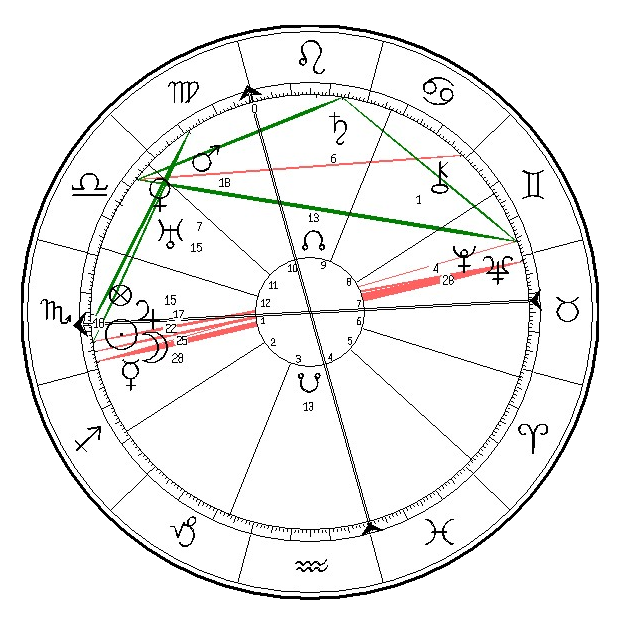
Georgia O’Keeffe
15. November 1887, 6.30 a.m.
Sun Prairie, Wisconsin, US
Source: Astrodienst – www.astro.com
The discovery of Pluto happened in 1930, when she was in her early forties. Its symbolism was gradually observed by astrologers to be about forces of nature, gods and goddesses of death and rebirth, empowerment, the underworld, healing transformation, ecstasy, what’s beneath the surface, including the invention and use of X-rays.
Her birth chart had a beautiful stellium of planets. Although the original source of the exact time of her birth is unknown, we know she was born on a New Moon day with the Sun and Moon plus Mercury and Jupiter constellated in the sign of Scorpio very close to one another. This stellium was opposite the Neptune-Pluto conjunction.
At first glance it was a birth chart about deep inner exploration, the depth of feeling and the possibility – like X-rays – of looking deeply into the nature of things. And this was to be balanced and integrated with the impressions and impulses from the great conjunction of Neptune and Pluto.
Venus in her chart was conjunct Uranus — the latter being discovered in 1781 as the first of the three transpersonal planets observed through telescopes during the last three centuries of the first millennium — Uranus 1781, Neptune 1846, and Pluto in 1930.
Venus-Uranus aspects can indicate artistic genius and originality as well as love relationships with a great desire for freedom. The Venus-Uranus conjunction in her chart was in a harmonious aspect — a trine — to the Neptune-Pluto conjunction, indicating that she could express impulses from these planetary archetypes through her love and creative work with ease. As a young woman in her twenties she was ‘incredibly independent, free-spirited and strong-willed’.2From the video: Hiding in Plain Sight: The O’Keeffe We Never Knew, a conversation between Katrina Latka from the Georgia O’Keeffe Museum and journalist Tim Gihring, who brings ‘art and history to life through storytelling’ and is quoting from the book: ‘Georgia O’Keeffe’s Wartime Texas Letters’ published in 2020.

Why of course I feel free … it never occurred to me to feel any other way.
—Georgia O’Keeffe 3Ibid. (See note 2)
She already knew from the age of 11 that she was to become a painter. Later in life she described her childhood in very few words: ‘It was always: “more of Georgia’s crazy notions”. They never approved of me. My mother and I never agreed. I would just not talk about the things we would disagree about’.4Quote from the documentary: ‘Georgia O’Keeffe’, 1977, written and directed by Perry Miller Adato.
With the Sun and Moon plus Mercury and Venus prominently aspected to transpersonal planets, her personality was not likely to fit easily into the consensus, everyday reality. Rather, her birth chart pointed towards possibilities of giving birth to something new from within her own core and soul.
Mars was in Virgo forming a sextile — also a harmonious aspect — to the stellium in Scorpio. And finally Saturn, the planet of manifestation, structure, constriction, contracts, stability, and personal autonomy was in the sign of Leo close to — although not conjunct — the North Node, indicating her soul’s calling which, among other things, was about becoming a teacher and a master within the arts. Saturn was exclusively harmoniously aspected — thus forming a trine to the stellium in Scorpio, a sextile to the Neptune-Pluto conjunction, and a sextile to the Venus-Uranus conjunction in Libra. She was said to have a natural authority.5You can read about the development of this during her childhood years and youth in the excellent biography: Georgia O’Keeffe: A Life (1999), by Roxana Robinson.
The Venus-Uranus and the Neptune-Pluto archetypal combinations appear in her paintings as an almost supernatural beauty emanating from the nature scenarios and flowers that so often were her motives. It was as if she saw deeply and beyond physical boundaries into the soul of the flowers, the landscapes, and any motive she would choose to draw or paint.
Her abstractions would also derive from e.g. flower motives, and they were expressions of the essence as she saw it with her mind’s eye. Oftentimes she would paint the same motive over and over again, until she eventually extricated its abstract essence.
One of the characteristics of modernism was that the artists would create from their inner experience of their motives — and thereby articulate the new and different Zeitgeist evoked by the conjunction of Neptune and Pluto.
‘I had to create an equivalent for what I felt about what I was looking at — not copy it’, Georgia once said, and this was also an apt expression of the stellium in her birth chart: The Sun seeing from the heart, the Moon feeling, Mercury communicating the impressions, and Jupiter expanding and enlarging.
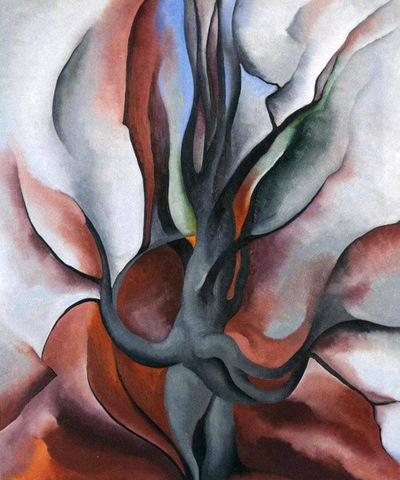
Autumn Trees – The Maple, 1924
Oil on canvas, 36 x 30 inches. Georgia O’Keeffe Museum (Santa Fe).